
2025-2028
Construction and application of a global prokaryotic operon sequence database using meta-omics data and deep learning models
National Natural Science Foundation of China, General Program, Grant No. 32470697. Principal Investigator.
The PKU-EMBL Lab develops a high-throughput pipeline that transforms environmental microbial "dark matter" (微生物“暗物质”) into computable knowledge. Focusing on extreme habitats characterized by high salinity, high alkalinity, or low temperature, we develop molecular biology technologies and intelligent analytical methods for systematic microbial genome reconstruction and functional annotation.
The resulting structured omics data provide training resources for domain-specific artificial intelligence models while supporting the development of intelligent algorithms and predictive models for microbiome research. The pipeline currently integrates three connected levels, progressing from genes to reactions to networks.
An end-to-end chain linking the physical world — functional species, metabolic pathways, and interactions — to computable data and knowledge graphs through multi-omics molecular annotation and multi-agent AI, enabling protein discovery and intelligent control of microbial communities.
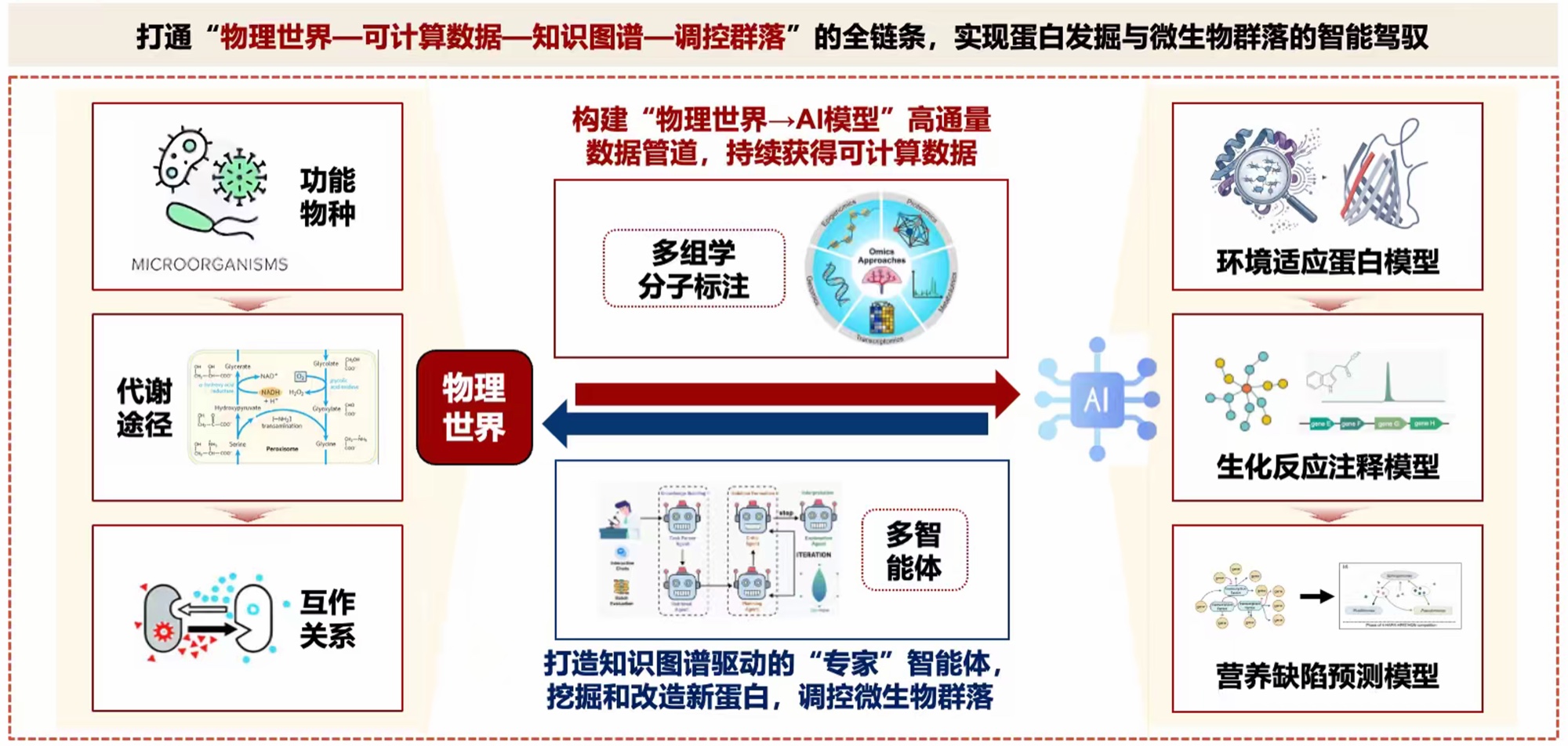
Together, these three levels form a progressive gene–reaction–network technology chain and establish a new paradigm for the intelligent solving of complex microbiome questions. In parallel, we are developing prototype microbiome AI models for core tasks including rare-taxon identification, metabolic pathway reasoning, and community-regulation simulation, creating a closed loop from data annotation to intelligent decision-making.
The lab has conducted large-scale metagenomic and metatranscriptomic sequencing, together with environmental physicochemical measurements, across extreme aquatic ecosystems in northwestern China, including salt, acidic, and alkaline lakes. The resulting datasets account for more than 80% of comparable data available globally. This unique data foundation supports both AI-driven discovery and rigorous training and validation of our in-house models.
Combining these data with our analytical methods, we have systematically uncovered previously unknown microbial lineages with potential functions and novel biosynthetic gene clusters for bioactive compounds. Cultivation and biosynthetic technologies are then used to advance these discoveries toward applications in environmental engineering, including pollutant bioremediation and biomass-to-energy conversion, and in pharmaceutical development through the discovery of novel bioactive natural products.
The lab has led General Program and Young Scientists Fund projects supported by the National Natural Science Foundation of China and has contributed as a core team member to over 20 research projects, including an NSFC Key Program and projects under the National Key R&D Program of China during the 14th Five-Year Plan.
National Natural Science Foundation of China, General Program, Grant No. 32470697. Principal Investigator.
Peking University AI for Science (AI4S) Interdisciplinary Research Program. Principal Investigator.
National Key R&D Program of China, Biomacromolecules and Microbiome Key Special Project, Grant No. 2021YFA1301300. Subproject Leader.
National Natural Science Foundation of China, Key Program, Grant No. 51939009. Collaborating Unit Co-Leader.
National Natural Science Foundation of China, Young Scientists Fund, Grant No. 51709005. Principal Investigator.
The lab's official GitHub organization is PKU-EMBL. The core software project is BASALT, a Nature Communications toolkit for metagenomic binning and refinement. Related software includes BASALT-Air.
Research led by Tenured A/Prof. Ke Yu includes more than 100 SCI-indexed papers and over 6,000 citations, with first-author or corresponding-author publications in broad-interest, microbiology, environmental science, and environmental engineering journals including Nature Communications, Microbiome, Environmental Science & Technology, and Water Research. He has been named among the World's Top 2% Scientists (Stanford University, 2025) and serves as Senior Editor of Microbiome and an editorial board member of iMeta, in addition to serving as a doctoral supervisor in both environmental science and engineering and computer applied technology at Peking University. His first-author metatranscriptomics study on activated sludge microbiomes was recognized by Prof. Per H. Nielsen as one of the landmark methodological studies for understanding activated-sludge microbial ecology over the past five decades. Another multi-omics study was highlighted by Prof. Marvin Whiteley for advancing methods to study interspecies microbial interactions.
WeChat official account

PKU EMBL